Market opportunity
Traditional predictive maintenance relies on periodic spot checks by skilled technicians — leaving high-value machinery unmonitored between visits. The emergence of low-cost embedded processors and wireless connectivity makes continuous, distributed vibration monitoring economically viable for the first time. SensiML's vibration classification models enable cost-effective smart sensor networks that cover entire factory floors, providing continuous fault detection without human intervention.
What SensiML brings to market
SensiML's vibration classification platform enables factory managers to deploy smart, trainable ML sensor networks across both new and legacy machinery — standardizing monitoring at scale without impacting existing systems. Models are built to classify multiple machine states simultaneously (on/off, fault types, anomalies), providing actionable intelligence rather than simple threshold alarms. The platform's fast retraining capability allows models to adapt as equipment ages or operating conditions change.

Capabilities & IP
Continuous
Always-on monitoring vs. periodic spot checks
Edge AI sensors with SensiML models replace manual inspection cycles with real-time fault detection — improving uptime and yield.
Legacy + new
Deployable on existing equipment without infrastructure changes
Over-the-top sensor nodes add intelligence without touching existing controls, PLCs, or connectivity networks.
Low-cost IMU
Commodity sensor hardware — no specialized hardware required
A standard IMU and MCU is sufficient. SensiML models deliver multi-state classification from widely available, low-cost components.
Proven use cases
- Fan state classification (7-state detection demonstrated)
- Motor and pump fault prediction
- Industrial bearing and drivetrain anomaly detection
- Manufacturing line quality assurance via vibration signature
- Infrastructure monitoring (bridges, pipelines, HVAC)
- Transportation and fleet asset health monitoring
IP & technical differentiators
- Multi-state classification from a single low-cost IMU + MCU
- Decentralized architecture: no single point of failure
- Fast model retraining as machine behavior evolves over time
- Validated 7-state fan classification on commodity hardware
- Compatible with both new deployments and legacy equipment overlay
SensiML's ability to deliver factory-scale, distributed vibration monitoring using commodity hardware — with no infrastructure changes required — dramatically lowers the barrier to deployment versus traditional condition monitoring systems, creating a large greenfield opportunity in under-served mid-market manufacturing.
See it in action
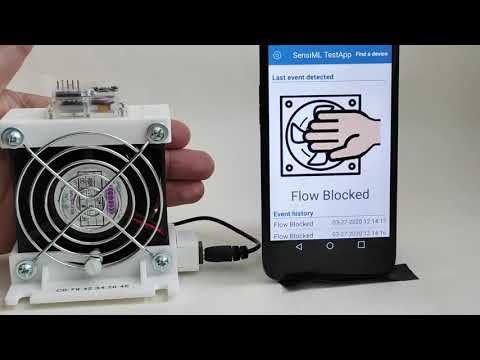
Fan State Classification Demo
7-state vibration classification on commodity hardware — validated and production-ready.

